Key Takeaways
- Top pick for 2026: InfrOS. It's the only platform that enforces cloud cost governance before resources are provisioned, not after the damage is done.
- Cloud governance has moved from a compliance checkbox to a core engineering discipline. Teams that skip it face spiraling costs, configuration drift, and audit failures.
- The most effective cloud governance tools combine policy enforcement, cost controls, and multi-cloud visibility in a single workflow.
- An IT cost optimization framework built around shift-left governance can reduce cloud waste by up to 43% compared to reactive FinOps approaches.
- Engineering teams get the most value from governance tools that integrate directly into IaC pipelines and CI/CD workflows, not standalone dashboards.
Why Engineering Teams Can't Skip Cloud Governance in 2026
Cloud environments don't stay clean on their own. A team of five engineers can spin up hundreds of resources across AWS, Azure, and GCP in a single sprint. Without consistent guardrails, what starts as a well-structured environment becomes a tangle of untagged instances, orphaned storage volumes, over-permissive IAM roles, and unexplained line items on the monthly bill.
This is the core problem cloud governance tools exist to solve. And in 2026, the stakes are higher than ever.
Three forces are making governance non-negotiable. First, multi-cloud is now the default. Most engineering teams operate across at least two cloud providers, and maintaining consistent policies across different control planes, AWS Organizations, Azure Policy, GCP Organization Policies, requires tooling, not manual effort. Second, AI workloads are inflating cloud spend faster than any previous technology wave. GPU compute, large-scale inference, and data pipeline infrastructure don't forgive misconfigured autoscaling or missing budget alerts. Third, compliance requirements are getting stricter. GDPR, SOC 2, HIPAA, and industry-specific frameworks all demand audit trails, encryption enforcement, and access controls that only systematic governance can reliably deliver.
The engineering teams that treat governance as a one-time setup task will keep paying for it in post-deployment rework, surprise bills, and audit findings. The ones embedding governance tools into their daily workflows are shipping faster and spending less.
What Makes a Cloud Governance Tool Enterprise-Ready
Not every tool that calls itself a governance platform is actually built for engineering teams operating at scale. Here's what separates enterprise-ready cloud governance tools from the rest.
Automatic policy enforcement. The tool must enforce rules, not just report on violations. If a misconfigured resource can reach production because the policy engine only flags it after the fact, it's a monitoring tool, not a governance tool. Look for enforcement at the IaC level, in CI/CD pipelines, or at the cloud API layer before provisioning completes.
Multi-cloud support across AWS, Azure, and GCP. Single-cloud governance tools create blind spots the moment your team deploys anything outside that provider. A genuine enterprise solution applies consistent policies and visibility across all three major clouds from a unified control plane.
Granular cost alerting and budget guardrails. Cloud cost governance requires more than a monthly budget threshold. Effective tools provide per-service, per-team, and per-environment budget limits with real-time anomaly detection, so cost spikes surface within hours, not at month-end.
Enforced tagging standards. Tagging is the foundation of cost attribution, access control, and cleanup automation. An enterprise-ready tool makes tagging non-negotiable, resources that don't meet tagging requirements fail validation before they're deployed.
Drift detection. Infrastructure drifts from its intended state constantly. Governance tools need to continuously compare running resources against the declared baseline and surface deviations before they create security gaps or compliance failures.
Together, these capabilities create the foundation of an IT cost optimization framework that scales with engineering teams across AWS, Azure, and GCP. When governance is embedded early, teams can control spend, maintain compliance, and reduce operational overhead without slowing down deployments
9 Best Cloud Governance Tools for Engineering Teams in 2026
The tools below were selected based on depth of policy enforcement, multi-cloud coverage, IaC integration, and real-world impact on cloud cost governance. Each has a distinct strength and a clear use case. InfrOS is listed first because it's the only platform that addresses governance at the design stage rather than after deployment.
1. InfrOS
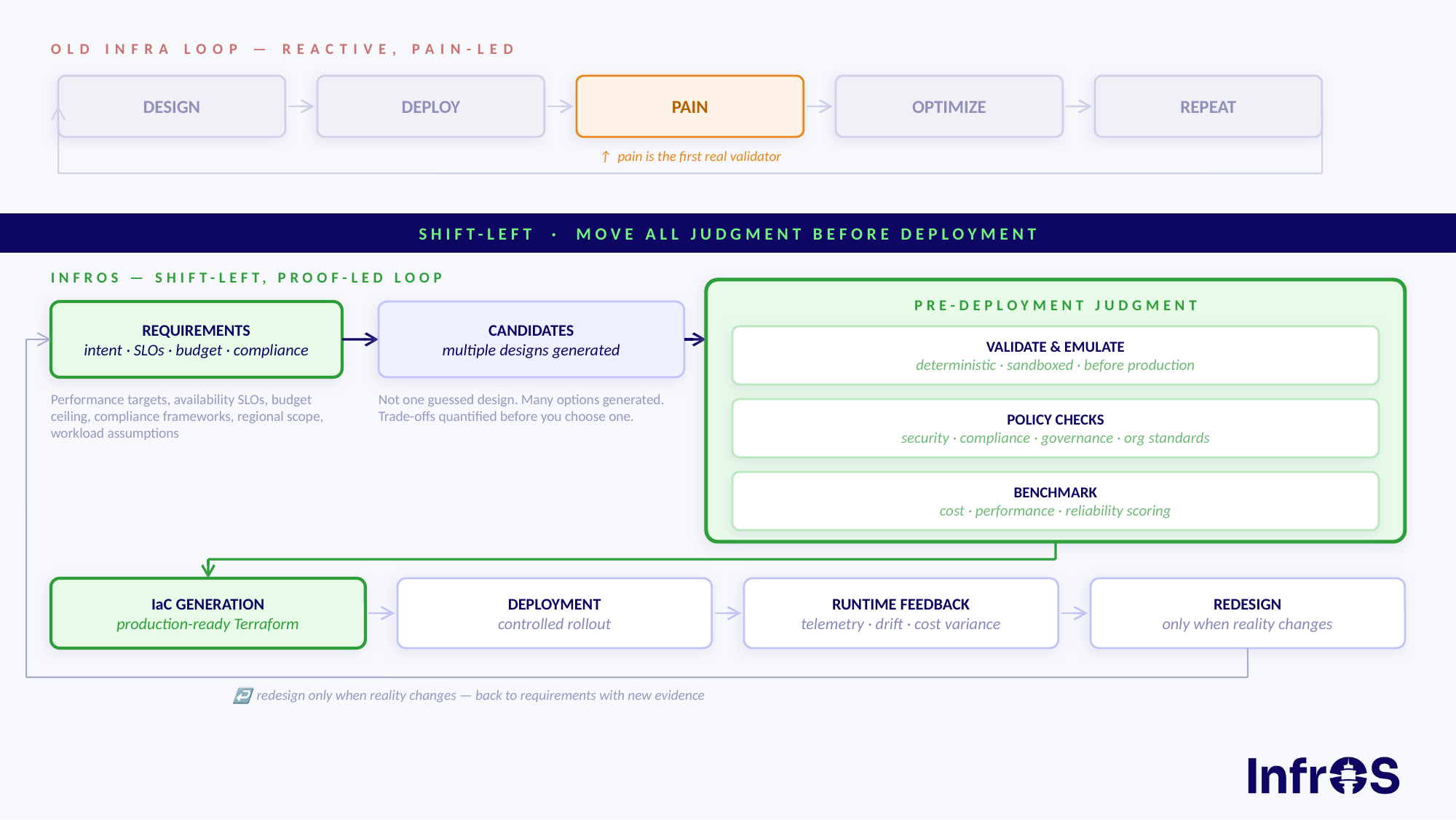
InfrOS approaches cloud governance from the direction most tools ignore: the design phase. Before a single resource is provisioned, InfrOS validates architecture candidates against cost targets, compliance policies, security requirements, and performance benchmarks, in a sandboxed emulation environment.
Key features:
- Pre-deployment architecture emulation and policy validation across AWS, Azure, and GCP
- Automated cost benchmarking with deterministic results before IaC is applied
- Production-ready Terraform generation with embedded compliance guardrails
- Continuous lifecycle optimization and drift detection after deployment
- Runtime feedback loop that feeds real-world performance data back into the next design cycle
Where most governance tools catch problems that already exist in your environment, InfrOS prevents them from being introduced in the first place. For teams building new infrastructure or migrating workloads, that shift-left approach is what drives the 43% average infrastructure cost reduction seen across InfrOS deployments.
2. AWS Control Tower + Service Control Policies (SCPs)
AWS Control Tower is the native governance layer for organizations running multi-account AWS environments. It sets up a landing zone with built-in guardrails and uses Service Control Policies to restrict what member accounts can and cannot do.
Key features:
- Centralized governance across AWS Organizations
- Pre-built guardrails for security, compliance, and operational baselines
- Account vending with consistent baseline configurations
- Integration with AWS Config for continuous compliance monitoring
Control Tower is the right choice for AWS-first organizations that need to govern a large number of accounts consistently. Its limitations show in multi-cloud environments, where it has no visibility outside AWS.
3. Azure Policy + Microsoft Defender for Cloud
Azure Policy lets teams define and enforce rules across Azure subscriptions and management groups. Combined with Microsoft Defender for Cloud, it provides continuous security posture assessment alongside policy enforcement.
Key features:
- Policy assignments at the subscription and management group level
- Built-in policy definitions for compliance frameworks including CIS, NIST, and PCI DSS
- Automatic remediation tasks for non-compliant resources
- Regulatory compliance dashboard with audit-ready reporting
For organizations heavily invested in Azure, this combination delivers deep governance coverage without additional tooling. Multi-cloud teams will need supplementary solutions for AWS and GCP workloads.
4. HashiCorp Sentinel (Terraform Cloud / Enterprise)
Sentinel is HashiCorp's policy-as-code framework built directly into Terraform Cloud and Terraform Enterprise. Policies are written in Sentinel's own language and evaluated against Terraform plans before apply runs, meaning violations are blocked before any infrastructure changes.
Key features:
- Policy evaluation at plan time, before any resource is provisioned
- Fine-grained enforcement modes: advisory, soft-mandatory, and hard-mandatory
- Native integration with Terraform's plan output for detailed violation context
- Support for cost estimation policies alongside security and compliance rules
Sentinel is purpose-built for teams that standardize on Terraform. It's one of the strongest options for embedding an IT cost optimization framework directly into IaC workflows, because policies run as part of the normal deployment pipeline.
5. Open Policy Agent (OPA) + Conftest
OPA is an open-source, general-purpose policy engine. Combined with Conftest, a wrapper that makes OPA easy to use against Terraform plans, Kubernetes manifests, and Dockerfile configs, it becomes a powerful, flexible governance layer that works across any CI/CD pipeline.
Key features:
- Policy written in Rego, a declarative query language designed for structured data
- Works against Terraform plans, Kubernetes YAML, Helm charts, and Dockerfiles
- Lightweight and CI/CD native, runs as a step in GitHub Actions, GitLab CI, or any pipeline
- Active open-source community with a large library of reusable policy examples
OPA is the right choice for teams that want maximum flexibility and don't mind writing their own policies. It requires more upfront investment than commercial solutions but has no licensing cost and integrates with almost everything.
6. Cloud Custodian
Cloud Custodian is an open-source policy engine from Capital One, designed for automated resource management and compliance across AWS, Azure, and GCP. It's particularly strong for cleanup automation, finding and acting on idle, orphaned, or non-compliant resources at scale.
Key features:
- Policy library covering hundreds of resource types across three major clouds
- Real-time event-driven enforcement via CloudWatch Events, Azure Event Grid, and GCP Pub/Sub
- Automated remediation actions: stop, delete, tag, notify, or quarantine
- Scheduling for off-hours workload management and cost reduction
Cloud Custodian fills a gap that policy-as-code frameworks often miss: the ongoing management of what's already running. It's a strong complement to design-time governance tools like InfrOS or Sentinel. See how it fits into a broader cloud cost management strategy.
7. Wiz
Wiz is a cloud security platform that gives engineering and security teams deep visibility into risk across multi-cloud environments. It's built around an inventory and relationship graph that maps every resource, identity, network path, and vulnerability in a unified view.
Key features:
- Agentless scanning across AWS, Azure, GCP, and Kubernetes
- Security graph that surfaces attack paths, not just isolated findings
- Built-in compliance frameworks with automated evidence collection
- Integration with CI/CD pipelines for shift-left security scanning
Wiz is the strongest option for teams where security posture and compliance evidence are the primary governance concern. It's not a cost governance tool, but its policy and compliance capabilities are enterprise-grade.
8. Spot by NetApp (CloudCheckr)
Spot by NetApp, incorporating the CloudCheckr platform, provides multi-cloud governance with a focus on cost visibility, compliance reporting, and resource optimization. It's widely used in managed service provider (MSP) and enterprise environments where accountability across business units matters.
Key features:
- Multi-cloud cost allocation with showback and chargeback reporting
- Over 500 best-practice checks across security, cost, and availability
- Reserved instance and savings plan management with utilization tracking
- Role-based access control for multi-team and multi-client environments
Spot is best suited for organizations that need governance reporting across complex account structures, particularly where different teams or clients are billed separately for their cloud usage.
9. Checkov (by Bridgecrew / Prisma Cloud)
Checkov is an open-source static analysis tool that scans IaC files, Terraform, CloudFormation, Kubernetes manifests, ARM templates, and more, before they're deployed. It's fast, developer-friendly, and integrates into any CI/CD pipeline in minutes.
Key features:
- Over 1,000 built-in checks for security and compliance across all major IaC frameworks
- Supports custom policies using Python or YAML
- Native integration with GitHub, GitLab, and Bitbucket for PR-level feedback
- Graph-based analysis to catch complex misconfigurations that simple rules miss
Checkov is the entry point for many engineering teams starting with cloud governance. It's free, fast to set up, and provides immediate feedback on common issues like public storage buckets, missing encryption, and overly permissive IAM policies. Pair it with a runtime governance tool for complete coverage across the infrastructure lifecycle.
How Cloud Governance Tools Support Cost Control and Compliance
Cloud cost governance and compliance aren't separate concerns, they run on the same underlying infrastructure: consistent policies, enforced tagging, and budget guardrails applied systematically across every environment.
In practice, cloud cost governance works in layers. The first layer is prevention: catching expensive or non-compliant configurations before they're deployed. This is where InfrOS, Sentinel, and Checkov operate, evaluating IaC and architecture designs against cost targets and policy rules before a resource ever runs. The second layer is enforcement: ensuring running environments stay within budget and policy bounds. Tools like Cloud Custodian, AWS Config, and Azure Policy handle this by continuously checking live resources and triggering automated remediation when violations occur. The third layer is visibility: giving engineering, finance, and leadership teams a shared view of where money is going and why. This is where cost allocation tools with tagging enforcement and showback reporting add value.
An effective IT cost optimization framework connects all three layers. It starts with design-time validation to prevent structural waste from entering production in the first place. It enforces tagging standards so every resource can be attributed to a team, environment, and business unit from day one. It sets budget thresholds at the service, account, and team level, with real-time anomaly alerts rather than monthly surprises. And it creates a feedback loop, runtime data flows back into the next architecture review, so the environment continuously improves rather than drifting toward waste.
The most common failure mode teams encounter is treating governance as a reporting exercise. Dashboards that show you what you spent last month are useful context. Policies that prevent overspending from happening in the first place are what move the needle. The best cloud cost optimization tools share a common characteristic: they make cost a constraint at design time, not a metric to be reviewed after the fact.
For compliance, the same principle applies. Running an audit after deployment to check whether encryption is enabled or public access is blocked is better than nothing. But policy enforcement in IaC pipelines, blocking non-compliant configurations from being merged and deployed, eliminates entire categories of audit findings before they occur.
FAQ
What is the difference between cloud governance and cloud management?
Cloud governance defines the rules, policies, and standards that determine how cloud resources should be used, who can deploy, what configurations are allowed, how costs are attributed. Cloud management is the operational work of running environments within those rules: provisioning, monitoring, scaling, and incident response. Governance sets the guardrails; management drives within them.
How do cloud governance tools work with IaC pipelines?
Most modern governance tools integrate as a step in CI/CD pipelines, evaluating Terraform plans, CloudFormation templates, or Kubernetes manifests before they're applied. Tools like Sentinel, OPA, and Checkov block non-compliant changes from merging or deploying. This shifts enforcement left, so violations are caught during code review rather than in production.
Can one tool enforce policy across AWS, Azure, and GCP?
Yes, tools like InfrOS, Cloud Custodian, OPA, and Wiz all operate across multiple cloud providers from a single control plane. Native provider tools (AWS Control Tower, Azure Policy, GCP Org Policies) are powerful within their own ecosystem but require separate configuration for each provider. Multi-cloud governance is best handled by platform-agnostic tools with native integrations across all three.
How do these tools help reduce cloud spending?
Cloud governance tools reduce spend by preventing waste before deployment and continuously enforcing policies after resources go live. They catch overprovisioned services, missing budget guardrails, and untagged infrastructure early, then automate cleanup and alerts so teams spend less time reacting to unnecessary cloud costs.



.jpg)