
Cost Management

Top Cloud Cost Management Platforms For 2026

Omer Shafir
Mar 4, 2026
·
6 min read

‍TL;DR: Key Takeaways

  • ‍Top Pick for 2026:
    InfrOS.
    Built to handle the "Cloud Complexity" with automated workflows that actually respect engineering time.
  • ‍The Shift:
    ‍
    Cloud spend is no longer a finance problem. It's a core engineering metric, just like latency or uptime.
  • ‍Real-Time or Bust:
    ‍
    Quarterly reviews are dead. If you aren't optimizing continuously and automatically, you're overpaying.
  • ‍Unit Economics:
    ‍
    Knowing your total bill isn't enough. You need to know exactly what it costs you to support a single customer or ship a specific feature.

When you’re scaling fast, finding the right cloud spend management platform isn’t about looking for more charts to ignore.

It’s about designing the right architecture before you deploy - so you don’t burn cash in the first place.

Why Cloud Cost Management Matters More Than Ever in 2026

In today's landscape, if you wait three months to catch a misconfigured dev environment, you've already nuked your margins. Modern teams have shifted to continuous cost optimization because the speed of the cloud demands it.

Costs now fluctuate by the minute, not the month. To keep your edge, you have to integrate cost data directly into your CI/CD pipelines. This ensures every deployment is evaluated for its fiscal impact before it ever touches production. It’s the only way to avoid those painful end-of-month conversations with finance.

Why Cloud Cost Management?

For a long time, the cloud bill was a CFO problem. They'd see a big number from AWS and ask you to "turn things off." We both know that doesn't work. Since you're the one provisioning resources, you're the only one who can actually control the spend.

This is driving the massive move toward engineering-driven accountability. You need a cloud cost management platform that shows you how your specific code changes impact the bottom line in real time. When you have that visibility, you can optimize on the fly, reducing friction and making "cost" just another part of the performance profile.

2026 Top Cloud Cost Management Platforms - 2026

Tools that handle multi-cloud complexity and deep container insights without adding more manual work to your plate dominate today’s leaders. Here is how the market looks right now.

‍

1. InfrOS

InfrOS is designed for teams that want to fix cost at the infrastructure level - not apply patches to broken architectures.

  • Shift-left architecture design based on actual product and business requirements.
  • Capacity planning and holistic right-sizing aligned with performance and reliability goals - without permanent over-provisioning.
  • Full cloud emulation to benchmark cost, performance, resilience, and security before deployment
  • Vendor-agnostic, fully documented IaC with embedded policy and budget guardrails.
  • CI/CD integration for continuous architectural optimization across new and existing environments.

2. Apptio Cloudability

Apptio is the go-to if your primary goal is giving finance full visibility and accountability over cloud spend across business units.

  • Showback and chargeback across teams and cost centers
  • Budgeting and forecasting based on historical spend
  • ERP and finance system integrations

3. CloudHealth

If you're in a massive enterprise with heavy compliance needs, CloudHealth is a solid, established choice.

  • Robust policy-driven governance and compliance controls.
  • Deep integration if you're already in the VMware ecosystem.
  • Extensive multi-cloud reporting for complex portfolios.

4. Finout

If you want flexible cost allocation without rebuilding your tagging strategy, Finout gives you layered visibility across cloud and SaaS spend.

  • Virtual tagging layered on top of existing billing data.
  • Custom cost grouping across cloud and SaaS.
  • Supports strategic planning conversations.

5. CloudZero

If you want cloud cost treated as a product metric - not just a finance number - CloudZero is built around unit economics.

  • Unit economics tracking aligned to products and customers.
  • Cost allocation without heavy reliance on rigid tagging structures.
  • Designed to connect engineering decisions with business outcomes.

6. Umbrella

If you’re looking for an AI-driven platform that helps you detect waste and plan future cloud spend across multi-cloud, Kubernetes, and SaaS - Umbrella is built for that.

  • AI-driven detection of cost anomalies and waste
  • Insights into spend trends to support planning decisions
  • Designed to help teams prioritize cost issues to address

7. Kubecost

If your world is 100% Kubernetes, Kubecost provides the granular data you need to understand cluster costs.

  • Detailed cost breakdown by cluster, namespace, deployment, and service.
  • Open-source core for those who want to kick the tires first.
  • Precise breakdown of storage, network, and compute within the cluster.
  • Good for high-security, air-gapped environments.

8. Attribute

If tagging isn’t telling you the full story of who owns your cloud bill, Attribute is built to go deeper.

  • Advanced cost attribution that maps spend to products, features, and services beyond basic tagging.
  • Connects infrastructure usage patterns to real ownership.
  • Designed to surface true cost drivers, not just billing categories.

9. PointFive

If your biggest frustration is discovering cloud waste long after the money is gone, PointFive is built to surface it early and clearly.

  • Identifies idle, underutilized, and orphaned resources across cloud environments.
  • Highlights actionable savings opportunities without requiring deep manual analysis.
  • Designed to uncover cost inefficiencies that traditional dashboards often miss.

10. Infracost

Infracost is built for teams that want cost visibility directly inside their Infrastructure-as-Code workflows.

  • Cost estimates embedded in Terraform pull requests.
  • CI/CD integration for pre-deployment cost visibility.
  • Developer-focused cost breakdowns.
  • Helps teams compare infrastructure changes before merging.

Core Capabilities to Look for in Cloud Cost Management Tools

When you're choosing a cloud cost management platform, don't just look at the dashboard. Look for the features that actually support a FinOps cloud cost management strategy.

  • Cost Modeling Beyond Spend: Reporting past spend isn’t enough. The right platform should simulate cost in different scenarios and structural waste before and after deployment.
  • Kubernetes Visibility: If the tool can't see into your clusters at the label level, it's not going to help you.
  • Unit Economics: You need to know your "cost per customer" or "cost per transaction" to see if your growth is actually healthy.
  • Automated Optimization: A tool that just tells you there's a problem is just another alert. You want a tool that can actually model and fix it.
  • Forecasting: Look for cloud cost management tools that use machine learning to give you a realistic look at where you'll be in six months.

FAQ

What’s the difference between cost visibility and cost optimization?

‍Visibility is just seeing the damage on a dashboard. It’s useful, but it doesn’t save you money. Optimization is the active, often automated, process of rightsizing resources and deleting waste. You need visibility to know where to look, but you need optimization to actually move the needle.

How long does it take to see ROI from Cloud Cost Management Platforms?

‍You should see a return within the first month or two. Usually, the "quick wins" come from killing orphaned resources or dev environments that should've been turned off weeks ago. The

long-term value comes from changing how your team actually models, builds, and deploys.

Are Cloud Cost Management platforms suitable for mid-sized engineering teams? ‍

They're arguably more important for you. You don't have the infinite budget of a FAANG company, so every dollar wasted is a dollar you aren't spending on new features or dev. These platforms let you scale efficiently without needing a dedicated 10-person FinOps team.

Can these platforms manage AWS, Azure, and GCP together?

‍Most of the top-tier platforms are built for a multi-cloud world. They'll give you a unified view so you can compare costs across providers and avoid getting locked into one vendor's ecosystem. This is pretty much a standard requirement in 2026.

‍Why the Differences Matter

  • Automation vs. Recommendation: Most enterprise tools like CloudHealth or Apptio are great at generating 50-page PDFs telling you that you're overspending. The problem is, they leave the actual work of fixing it to your already-slamped engineering team. We've built InfrOS to handle the remediation itself, so you aren't just seeing the problem, you’re solving it.
  • Kubernetes Intelligence: Kubecost is fantastic if you live 100% inside a cluster, but it loses the plot the second you have to manage RDS, S3, or cross-cloud egress. We've combined that deep container granularly with a "whole-cloud" view.
  • Shift-Left FinOps: We believe cost should be caught in the PR, not the bill. By integrating with your CI/CD pipelines, InfrOS makes it possible to see exactly how much a new feature will cost before it’s even merged.

Next Steps

Reduce structural cloud waste by up to 43% before traditional FinOps initiatives even begin - by engineering cost efficiency into your infrastructure and modeling spend before it hits your bill.

Keep on reading

Events
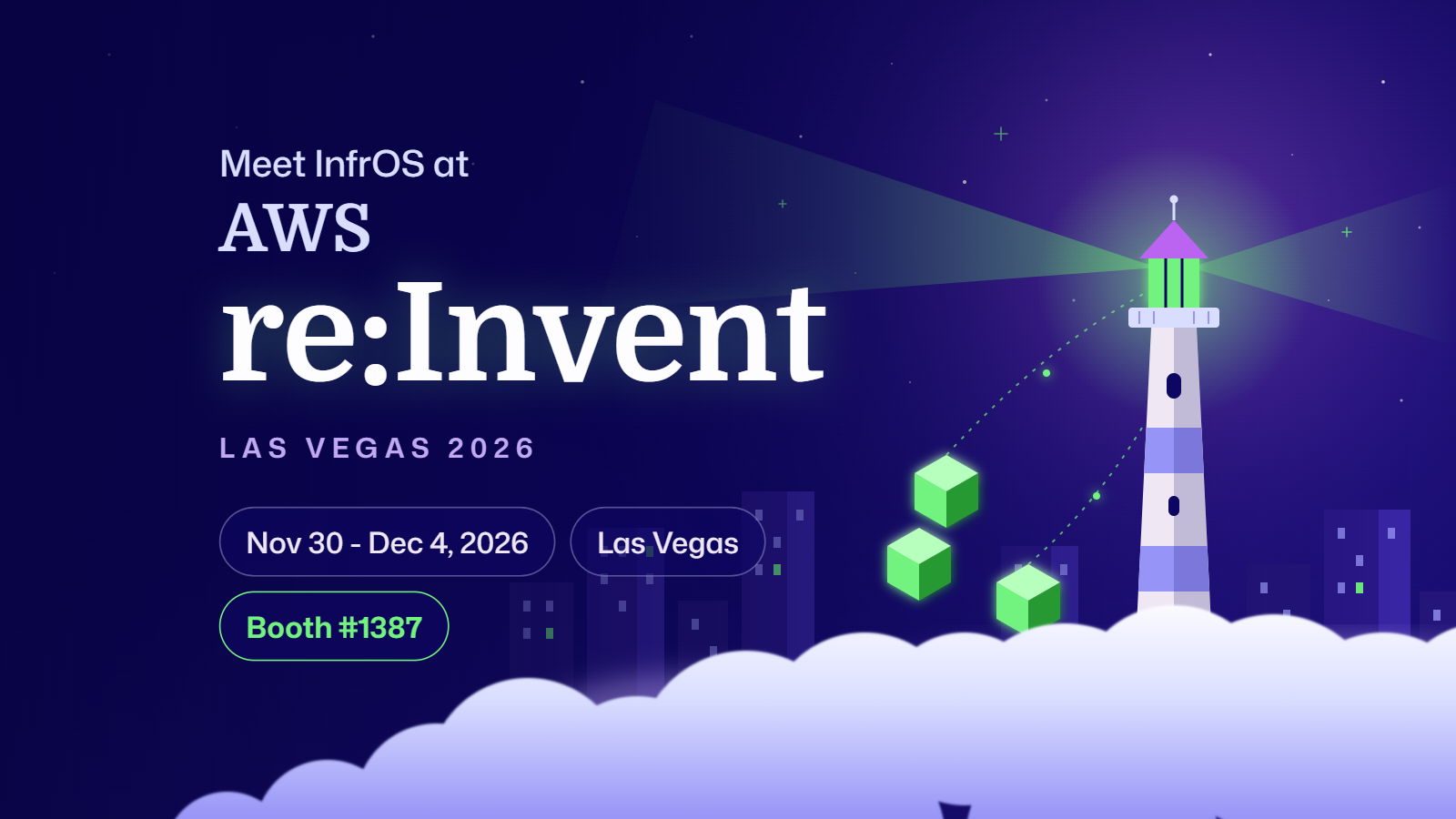
Meet InfrOS at AWS re:Invent 2026 in Las Vegas
Guy Brodetzki
Oct 11, 2026
·
6 min read

InfrOS is excited to be exhibiting at AWS re:Invent 2026 in Las Vegas!

We'll join the global cloud community to talk about how to build better cloud systems, cut costs, and keep them secure and reliable.

Make the Whole Thing Work at Booth #1387

Cloud architecture is complicated enough. Come have some fun at our booth:

  • Pull the lever: Set our Rube Goldberg machine in motion and win a prize.
  • Enter our daily raffles: Get a chance to win even bigger prizes.
  • Meet the team: Chat with us and see InfrOS in action with a live demo.

Meet Our Team

Our founders and team members will be at the event to meet cloud architects, engineering leaders, and organizations looking to improve their cloud infrastructure:

Schedule a Meeting with Us

We'd love to connect! Stop by for a quick chat or book a meeting in advance to see InfrOS in action.


Book a Meeting with InfrOS


See you in Las Vegas!

‍

Events
Meet InfrOS at KubeCon + CloudNativeCon North America 2026
Guy Brodetzki
Oct 11, 2026
·
6 min read

InfrOS is heading to KubeCon + CloudNativeCon North America 2026!

We'll join the global cloud community to talk about how to build better cloud systems, cut costs, and keep them secure and reliable.

Make the Whole Thing Work at Booth #360

Cloud architecture is complicated enough. Come have some fun at our booth:

  • Pull the lever: Set our Rube Goldberg machine in motion and win a prize.
  • Enter our daily raffles: Get a chance to win even bigger prizes.
  • Meet the team: Chat with us and see InfrOS in action with a live demo

The Best Seats aren't at KubeCon

Join InfrOS on November 11 for an NBA game in our private skybox as the Utah Jazz take on the Orlando Magic. It's a chance to catch the game, meet fellow attendees, and spend time with the InfrOS team away from the conference floor.
‍

Register for the event here

Meet Our Team

Our team will be available throughout the event to discuss your infrastructure challenges and demonstrate the InfrOS platform.

Here's our team attending the event:

Let's Meet

Have an infrastructure challenge you'd like to discuss? Stop by our booth or schedule a dedicated meeting with our team.


Book a Meeting with InfrOS


See you in Salt Lake City!

‍

Cloud Architecture Design
9 Best Infrastructure Automation Tools for Cloud Engineering Team
Harel Dil
Sep 25, 2026
·
6 min read

Most cloud teams are already using cloud automation. There's Terraform in one repo, Ansible playbooks in another and a CI pipeline ties them all together. The problem is that "infrastructure automation tools" cover such a diverse range of use cases that it’s hard comparing them directly. In this blog post we’ll review 9 such tools, that actual task each one solves, and the niche it occupies. InfrOS is our product hence we will list it first, but we made sure to be fair in reviewing the rest. And also, we'll be upfront about our view - most cloud teams have too many tools stitched together, and we believe fewer is better.

‍Key Takeaways

  • Infrastructure automation covers provisioning, configuration, orchestration and, more recently, architecture decisions.
  • Terraform, OpenTofu, Pulumi and CloudFormation build infrastructure. Spacelift and env0 are infrastructure orchestration tools that run and govern those builds.
  • Almost every tool starts after someone has already picked the architecture. InfrOS works on that earlier step.
  • Most teams juggle too many tools. The fewer tools you work with, the fewer handoffs where things break.

What Counts as Infrastructure Automation

Infrastructure automation, for the purposes of the list, refers to software that performs a step within the process of creating, configuring, or maintaining an infrastructure component in an automated way instead of a manual one. This includes IaC, configuration management, the process of running and approving changes, and policy enforcement. General CI/CD systems like GitHub Actions or Jenkins were excluded because they belong to a separate category - they could run Terraform, but wouldn't know what infrastructure is. The same is true about monitoring solutions that merely point at broken parts of an infrastructure but don't fix it.

Automating a Decision Is Not the Same as Automating Deployment

The vast majority of tools perform an action according to the plan - you decide which cloud, regions, database, networking design and redundancy level you need, and the tool implements it. This is good, but the tool doesn't care whether your design was right or wrong. If your architecture costs you twice as much as it needs to, or collapses after region failure, Terraform will build it anyway.

A subset of these tools actually creates the design. They consider your requirements, contrast various architectural options and highlight the trade-offs in terms of costs, performance, resilience, and compliance before any implementation takes place. This is important because an architecture design mistake can easily be corrected on the whiteboard but would be very costly once implemented. For more details check out this blog post about shift-left cloud infrastructure design.

The 9 Best Infrastructure Automation Tools

With that split in mind, here's each tool, what it automates, how it deploys and who it fits.

‍

1. InfrOS

InfrOS covers the entire cycle in one single package. It first helps to identify your infrastructure as well as requirements. This is followed by creation of different architectural options for you and analysis of them based on cost, performance, resiliency, and compliance. Before making any choice, it simulates the behavior of all options. Thus, you will be choosing based on facts rather than guesswork. Finally, after selecting one option, InfrOS helps to generate infrastructure as code and deploy the same. It will keep monitoring the live environment to inform you about better options whenever available. We call this Evolving Architecture™.

Recommended for: Cloud teams working in one or multiple clouds who seek a single solution for their design, validation, IaC and ongoing assessments.

‍

2. Terraform

Terraform remains the default choice for most teams, and deservedly so. Describe infrastructure in HCL files, execute the plan to see the changes to be done, and then apply those changes. With hundreds of providers, it can connect to pretty much any cloud or SaaS APIs. Nearly all Terraform automation done at scale happens either via HCP Terraform or a third party orchestrator which provides capabilities of remote executions and state management.

Best for: Pretty much any team that starts with IaC, especially in the context of multiple clouds.

Watch out for: HashiCorp put Terraform under Business Source License in 2023. HashiCorp got acquired by IBM recently. For most of us, nothing much changed, but for some companies, a fully open source option became preferable.

‍

3. OpenTofu

OpenTofu is the open-source fork of Terraform, created after that license change and now run under the Linux Foundation. Same HCL, same providers, very similar CLI, so moving over is usually a small job. It has also added features of its own, like built-in state encryption.

Best for: Teams that want the Terraform workflow with an open-source license and community governance.

Watch out for: The two projects are slowly drifting apart, so features don't always match.

‍

4. Pulumi

Pulumi allows for writing infrastructure using real programming languages such as TypeScript, Python, Go, C# and Java. This implies usage of loops, functions and unit testing instead of configuration language. It still operates through the desired state at its core meaning that you get to see the preview of each change before it is deployed.

Good for: Teams with a lot of developers willing to write code instead of learning HCL.

Keep in mind: With power comes increased ability to write messier infrastructures. Having a good system of code reviews in place is crucial.

‍

5. AWS CloudFormation

AWS CloudFormation is AWS’ own IaC solution. Using YAML or JSON templates AWS deploys and updates your infrastructure as a stack with rollback upon failure. Service itself is free but you have to pay for the resources it builds.

Good for: Teams which only use AWS and are interested in staying within their tooling ecosystem.

Keep in mind: It's AWS-only. The moment you start deploying your infrastructure to other clouds, you'll need another tool.

‍

6. Ansible

Ansible manages configurations of running servers. You craft playbooks using YAML format, and then Ansible connects via SSH to deploy packages, manage settings, and provision applications. There’s no agent involved, which makes the whole process straightforward.

Best for: Operations teams managing dozens of VMs, on-premise servers or networking devices. Usually used together with Terraform, where Terraform provisions and Ansible configures.

Be aware of: Ansible is not good with monitoring state of cloud resources, and therefore it’s not the best choice as a primary infrastructure provisioning solution.

‍

7. Spacelift

Spacelift is one of those infrastructure orchestrators that are sitting on top of your IaC. It allows running Terraform, OpenTofu, Pulumi, CloudFormation, Ansible, and Kubernetes workloads directly from your Git repositories. On top of it, it provides policies in code through Open Policy Agent, approvals, drift management and stack dependencies.

Best for: Platform teams with multiple stacks and multiple contributors that need some guardrails.

Be aware of: It’s one more platform to learn and use. Teams with only a few stacks probably don’t need it yet.

‍

8. env0

Similar in concept to Spacelift but focusing more on developer self-service and cost optimization, env0 allows platform teams to release approved templates for use by developers who build environments from those templates, with cost information added by env0 prior to deployment. If your concern is cloud governance, we've covered cloud governance tools for engineering teams before.

Best For: Organizations where developers should be able to spin up their own environments without giving them access to everything.

Beware: Like Spacelift, this is worth its weight in gold at scale.

‍

9. Crossplane

Crossplane is Kubernetes-as-a-control-plane for cloud infrastructure. Resources are defined as Kubernetes objects and managed through reconciliation (even when manual changes have been made), allowing platform teams to define APIs for themselves as a sort of wrapper, like a "database" object that handles all the cloud configuration under the hood.

Best For: Platform engineering teams who know their way around Kubernetes well.

Beware: This one's quite steep for those just starting with Kubernetes.

Tools Compared at a Glance

Here's how all nine line up on the same criteria.

ToolWhat it automatesHow you define itCloud scopeModelBest for
InfrOSArchitecture design, validation, IaC generation, deployment, ongoing checksRequirements and existing infrastructureSingle cloud, multi-cloud or hybridCommercialReplacing a multi-tool stack with one loop
TerraformProvisioningHCLMulti-cloudSource-available (BSL)General IaC
OpenTofuProvisioningHCLMulti-cloudOpen source (MPL)Open-source IaC
PulumiProvisioningTypeScript, Python, Go, C#, JavaMulti-cloudOpen-source coreDeveloper-led teams
CloudFormationProvisioningYAML or JSON templatesAWS onlyFree AWS serviceAWS-only teams
AnsibleConfigurationYAML playbooksAny server, any cloudOpen sourceServer and app config
SpaceliftIaC orchestration and policyWraps your IaCMulti-cloudCommercialPlatform teams with many stacks
env0IaC orchestration and self-serviceWraps your IaCMulti-cloudCommercialDev self-service and cost control
CrossplaneProvisioning through KubernetesKubernetes resourcesMulti-cloudOpen source (CNCF)Kubernetes platform teams

Swipe sideways to see all columns.

A few things jump out. Four of these tools (Terraform, OpenTofu, Pulumi and CloudFormation) do basically the same job with different languages and licenses, so you only need one of them. Spacelift and env0 only make sense once you have one of those four. And InfrOS is the only one that covers the steps before, during and after provisioning. So the real question isn't which tool is best. It's how many tools you actually need.

How These Tools Fit Together in One Pipeline

Consider the traditional pipeline to have four tiers. The first one is the decision tier where you select the architecture. The second is the definition tier where the architecture gets converted into code using Terraform, OpenTofu, Pulumi, or CloudFormation. Then, there is the orchestration tier where Spacelift or env0 executes the code with policy enforcement and approvals, or Crossplane does the same within Kubernetes. Finally, there is the configuration tier where Ansible configures the servers and applications.

‍

And that means four tools, four vendors, and four handoffs – and every single handoff becomes another point of failure. Instead, InfrOS uses a different approach, encompassing the decision-making, the IaC itself, the validation process and the monitoring within one loop, making it possible for you to remove quite a few elements from the stack rather than keeping it all running. This is end-to-end cloud automation, spanning design and live operations. Looping is important here because the process does not stop at deployment. Workloads evolve, pricing changes, new requirements come up – and an architecture that was perfect last year may no longer work.

 Keeping it in shape is an ongoing job, which our guide to cloud infrastructure optimization best practices covers.

FAQ

What is infrastructure automation?

It's the use of software for performing the tedious tasks of creating and managing the infrastructure. The tasks include coding of the infrastructure, provisioning of cloud resources, server configurations, approvals and policy enforcement. This aims at improving the speed, repeatability, and accuracy of change. More recent automation technologies extend the process of automation right from the stage of architectural designs to determine the best architecture options.

‍

What is the difference between automation and orchestration?

Automation is getting one task done without a person, like creating a database with a single Terraform apply. Orchestration is coordinating many automated tasks into one flow, in the right order and with the right checks. Think provisioning, then a policy check, then an approval, then configuration. Spacelift and env0 are infrastructure orchestration tools, while Terraform and Ansible are mostly automation. Once things grow, you usually need both.

‍

Do these tools replace Terraform?

Automation involves getting a single task completed without human intervention, such as building a database through a single apply in Terraform. On the other hand, orchestration involves managing all the automated tasks together as part of one workflow, in order and with the proper checks. For example, provision, policy check, approval, and configuration. Env0 and Spacelift are examples of infrastructure orchestration tools, whereas Terraform and Ansible are more automation tools.

‍

Which infrastructure automation tools suit small teams?

Keep it simple. You typically need one infrastructure-as-code tool for a small group, such as Terraform, OpenTofu or Pulumi, that operates within the CI pipeline you’re already using. CloudFormation will do the job just fine if you're only working in the AWS environment. Orchestration platforms and Kubernetes tools like Crossplane are more likely to give you return value later down the line when you have many stacks.

‍

How do you measure the return on infrastructure automation?

Let's start from things that are quantifiable. Measure the time that is required to deploy a change, the number of deployments that failed, the amount of time spent handling manual tickets, and how frequently drift occurred. In case of architecture level automation solutions, let's not forget about comparing cloud costs to some kind of baseline and counting the number of designs that were avoided after the go live.

‍

Our post on a FinOps cost optimization agent shows one way to tie automation to real cost numbers.

About InfrOS

InfrOS assists cloud teams in choosing what to build, validating that decision prior to production, and adapting as needed going forward.

‍