AI agents are moving from experiments into production. They search internal knowledge, call APIs, write to databases, trigger workflows, and make decisions based on data pulled from many systems. That makes them far more useful than a traditional chatbot, and far harder to run reliably.
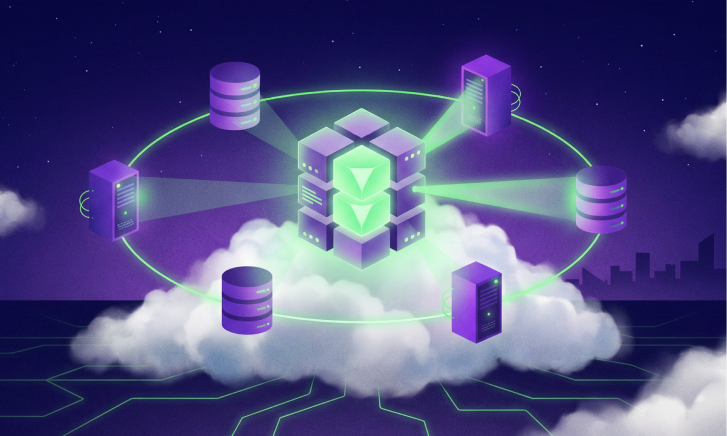
The reason is that an agent is not just a model behind an API. A production agent leans on a language model, databases, vector stores, external APIs, GPUs, identity systems, and internal apps. Some of that runs in the cloud, some has to stay on company servers. So the real question is not which model to use. It is where each part runs, how the pieces talk, what happens when one fails, and how it all holds up as usage grows. The architecture decisions around an agent matter more, and last longer, than the model you pick, so the time to make them is before anything is built. That is what building infrastructure for hybrid LLM agent deployments comes down to.
Key Takeaways
- Planning ahead matters more than the AI tools you pick. A strong model on a poorly planned architecture still ends up unreliable and expensive.
- AI agent infrastructure is not like normal app infrastructure. A single agent request can search a knowledge base, call several tools, hit multiple data sources, and invoke the model more than once. So instead of a fixed request-and-response path, you have a system that leans on models, data, networks, security, and many services all at the same time. That creates demands around latency, availability, observability, and cost that a standard web app never has to deal with.
- Hybrid deployments keep sensitive workloads on your own infrastructure while using cloud services where they make sense, but they add real complexity.
- Testing architecture choices before deployment prevents expensive redesigns later.
Why AI Agents Need Different Infrastructure
A normal app follows a predictable path. A user sends a request, the app reads or writes some data, and sends back a response. An agent is far less predictable.
Ask an agent to help investigate a customer issue and it might search a knowledge base, query a database, call an internal API, ask the model to reason over the results, decide it needs another tool, call that too, then answer and log the whole thing. Every step adds a dependency.
That changes the llm infrastructure requirements for production. The infrastructure has to support the model and everything around it: latency, availability, where sensitive data is allowed to go, what the agent can access, how it scales to thousands of users, what each interaction costs, and whether the team can see why it slowed down or failed. A prototype runs fine on a single endpoint and a laptop. Production has to account for all of it.
What "Hybrid" Means Here
Hybrid just means some of the system runs in the cloud and some runs on your own servers. Teams do this for a few reasons.
Sometimes it is about data. A financial firm might keep customer records in its own environment, let the agent pull them locally, and send only the needed context to a cloud model. Sometimes it is about the split between apps and models, where existing apps and databases stay on internal servers while model inference runs in the cloud and the agent connects the two. And sometimes it is about sensitivity, where routine work runs in the cloud and the most sensitive jobs stay on dedicated hardware.
The thing to remember is that hybrid is not automatically better. It adds networking, security, and operational complexity, so it should be a deliberate choice, driven by what the workload actually needs.
Common Setups Companies Use Today
There is no single right architecture, but a handful of patterns show up again and again:
- Cloud agent, cloud models. Everything runs in the cloud. Simplest to deploy, with elastic capacity and managed services, but costs climb fast as agents make more model and tool calls.
- On-prem agent, cloud inference. Orchestration and sensitive data stay internal while the model runs in the cloud. Good for control, but watch network latency and what data gets sent out.
- Hybrid inference. A small local model handles routine requests and a larger cloud model takes the hard ones. Balances cost and privacy, but routing and capacity planning get trickier.
- Cloud agent, private data. The agent runs in the cloud but critical databases stay on-prem behind controlled connections. Useful when internal systems can't easily move.
- Many environments. Big enterprises end up with agents across several clouds, regions, and internal systems. The job shifts from deploying one app to keeping a constantly changing architecture understandable.
Why Planning Ahead Beats Fixing Problems Later
This is where most of the cost hides. Building the first version fast and worrying about architecture later works fine while you are experimenting. It gets expensive in production.
Take an agent handling 100 requests a day. Nobody notices that each one crosses three network boundaries, hits two external services, and calls an expensive model. At 100 requests it is nothing. At 100,000 it is an architecture problem. Resilience works the same way: if the agent quietly depends on a single region, model provider, or database, that one failure takes it all down, and fixing it later means reworking networking, data flows, compute, and security at once.
Architecture decisions compound, so it pays to compare options before you commit: how cost behaves as usage grows, where latency builds up, which components are single points of failure, and what happens when a model endpoint goes dark. This is the shift-left idea applied to infrastructure. Instead of finding the problems after launch, you validate the design before committing to it. We go deeper on this in Shift-Left Cloud Infrastructure Design.
Planning ahead is not about predicting five years out. It is about making the tradeoffs visible before they get expensive, so the choice is deliberate instead of just whatever was easiest to ship first.
Planning for AI Training Infrastructure
Inference is only half the story. Teams that train or fine-tune models face another set of needs, and llm training infrastructure can call for serious GPU capacity, fast networking, big datasets, and careful scheduling. Even here, more hardware is not the fix. What matters is utilization. A common pattern is to keep dedicated GPUs for steady, high-volume work and rent cloud GPUs for occasional bursts. Underused dedicated hardware is just as wasteful as sloppy cloud spend, so plan around real workload behavior, not the theoretical maximum.
FAQ
What makes AI agent infrastructure different from regular app infrastructure?
The big difference is predictability. A normal app runs a fixed path. An agent decides what to do at runtime, so one request may branch across tools, data sources, and repeated model calls. Planning has to cover that variability, plus the latency, security, observability, and cost it brings.
What do companies need to plan for before running AI agents in production?
Plan for model capacity, data access, networking, security, latency, availability, observability, scaling, and cost. Map the critical dependencies and failure scenarios too. The most important step is understanding how the whole architecture behaves under real workloads, not just testing each component on its own.
Can a hybrid setup slow down AI agents?
Yes. Every hop between environments adds latency, especially when an agent keeps moving data between on-prem systems and the cloud. A good hybrid design limits this by keeping components that talk to each other often close together and cutting out unnecessary data movement.
How do companies plan ahead for training large AI models?
Start with workload size, GPU needs, training frequency, storage, networking, and utilization. Then compare dedicated infrastructure, cloud capacity, or a mix. The aim is enough compute for the workloads you actually run, without paying year-round for hardware that mostly sits idle.